Tuesday, August 11, 2015

Deutschland Unter Alles....


After a pretty non-descript journey to South Sweden where we suffered a night a Trelleborg, we boarded a ferry across the Baltic sea for a 6.5 hour trip to Rostock in North Germany. The Baltic Sea must be one of the most boring places on earth. There are no waves, things to see or even a bit of swell to rock the boat. We did pass one (Danish) island that was appropriately named Borre, (pronounced Borer), and it had white cliffs that could have shamed Dover.

The White Cliffs of Borre!
 
After this stunningly exciting island, we had virtually nothing to occupy ourselves with for the next 4 hours, although Iris did discover and purchase a large goody!
 
As this item is clearly marked "Not Choklad", we had no qualms about eating the entire block in one sitting.
 
So the bore cruise continued and although we passed a couple of smaller vessels to break the monotony, very little else happened until we were near Rostock. It then soon became apparent that there was some kind of "tall ships" regatta going on and we counted over forty, 2 or 3 masted sailing vessels of various vintages.
 
 
This was the first of the many sailing vessels that we came across. A 36 gun, French flagged, frigate. Part of me was admiring the lovely 18th century ship, whilst the other part was hoping a British man o' war would glide alongside and put a broadside through her.
 
Here's a view of the regatta and some of the other sailing ships.
 
 
A clipper, two-masted barque and a schooner as we were entering the port.
 
After disembarking in Rostock we set out on the road to Berlin. It was a quiet drive, being weekend and most traffic was heading out of Berlin in the opposite direction to us. Unfortunately, we had decided to stay at a campsite at a place called Malchow, about 2 hours north of the capital. It was called Malchow "Naturcamp". Unfortunately it contained no nature or naturists but was a latter day model of Stalag Luft 9, by a lake. Luckily, they let us escape the next morning provided that we paid the bill and it was but a small price to pay. (Well it wasn't actually, it was close to extortion).
 
So, on the Sunday we had a pleasant drive to Berlin and found an excellent campsite in the Berlin suburb of Kopenick. The amenities were quite basic but it was very close to the railway into Berlin and had a very nice bar within staggering distance of our campervan.
 
After settling in to the camp we got directions to the tram and after the first one that passed ignored us completely, the second driver gave us directions and was very helpful. We got on the tram, bought tickets, sat down comfortably, and then after about 150 metres got off again. We had reached the station for Berlin, hurrah! Fortunately, our tickets were transferable to the train.
 
We headed (by train) into Alexanderplatz, which was one of the focal points of the revolution when the Berlin wall finally fell. On Sundays it is a big open market and people from all over Germany set out their stalls in much the same way as in other metropolises. That is, they sell fast food and assorted Tat for whatever inflated price they can get. We did buy our lunch there and it was a reasonable vegetarian "wrap" of some middle eastern nature. We then wandered around looking at empty shops, (the malls were open but the shops were closed), until the furnace-like heat got too much and we decided to head back to Kopenick.
The big ball in the sky is at Alexanderplatz.
 
 
We managed our return trip successfully and avoided paying 5 euros for return tickets. Iris had done a swift calculation and decided that as our inward bound tickets were a bit expensive, we shouldn't pay the return bit. We got off the train at Kopenick and literally blundered into a bar across the road where we were able to slake our thirst. As I mentioned earlier, the temperature was in the high 30's so the Berlin Pilsener (for Iris) and a Pina Colada for me went down very nicely. (I may have got those drinks mixed up).
 
A double bonus was that the bar had the English Premier League, Stoke City vs Liverpool showing, and despite my objections, Iris insisted that we watch it. 4 glasses of beer later we had a 1-0 win for the mighty reds, (or blacks, as it happened to be their away strip). We also had a reasonably priced meal to dissipate the alcohol.
 
The next day it was back to Berlin stifling heat. We strolled along the river for a way and then visited the Berliner Dom or cathedral. The church doesn't belong to any of the established christian orders, (e.g. catholic or lutheran etc.) but is an evangelical outfit of some description. It was badly damaged during the second world war, along with the rest of Berlin, but has been restored. The building consists of a fairly small church surmounted by an enormous dome. It is well worth the entry fee.
 
 
Inside the dome.
 
We also visited the crypt of this church and the most notable inmate was Frederick the Great, who shuffled off this mortal coil in about 1688, followed by his missus the year after. There were innumerable other "nobles and royals" in caskets, sarcophagi, tins, (well one of them looked like a big tin), and assorted boxes. A couple of the boxes were so big the occupants must have been approaching the size of a hippo, or at the very least a small moose.
 
 
Friedrich der Grosse. I prefer the English interpretation as Gross!
 
We left Berlin this morning, heading for Luxembourg where we will meet up with Jo and Julien later in the week. Our stop this afternoon was at Gottingen, a  town where the local university was founded by George the Second, in his capacity as Elector of Hanover (which is fairly close to Gottingen). 
 
Gottingen in the late 19th and early 20th centuries was one of the world's leading scientific and mathematical universities and rivalled Oxford, Cambridge, Harvard and Yale in terms of its academic achievements and reputation.
 
In 1933 however, a certain Adolf came along and decided that as a fair proportion of the academic staff was Jewish, they should be replaced by people who thought proper, like him! And just like the rest of Germany, it has never been the same since.
 
We walked into the town to have a look see and were amazed by the number of late medieval buildings that were still extant. The town was virtually undamaged by bombing and with traffic banned from the centre, it is a really charming place to wander around, (despite the usual chain stores and similar blots on the landscape).
 
There were a number of plaques on various buildings through the town that named the academician who had resided there and when.

The only one that I recognised was Gauss, who (to me) was known for his pioneering work in electromagnetism. It turns out that he was also a gifted mathematician and strong in many other sciences too.
 
 
There were lots of mansions like this on the walk into town too.
 
There was also some interesting graffiti. Joe Stalin (I think) with some uncomplementary remarks.
 
We then stopped in at the P-Cafe for a quick hit before heading into the centre. (For those non-NZ readers, P is Crystal Meth).
 
 
 This was just about the pick of the buildings with carved and gilded wood, circa 1540.


 This little birdie, (I can't make up my mind whether it's a falcon or an owl), is the door handle on a really massive door to the main church. You can see the small keyhole just below the perch.
 
 
The town square and in the background the town hall or Rathaus, as these are named in Germany and the Scandinavian countries. I just love the idea of a gathering place for politicians being called a Rat House and think it should be adopted worldwide.
 
 
And finally, another fine medieval carving. Gottingen's answer to Paddington Bear, although without the hat and wellies.
 

Monday, August 10, 2015

Last Stop Oslo......


Finally back on line after several days wifi free......

We drove from Fagernes to Oslo for the last stay of our visit to Norway. During the drive, (about 3 hours), we reflected on the various animals that are depicted on road signs. The commonest sign warns against the mighty Moose, with warning signs liberally spread along every highway and by-way. The signs also show the number of up-coming kilometres in which you are likely to encounter them. Needless to say, we saw hide nor hair of any of them. There were a couple of moose tours advertised in places we stopped, with marketing statements like, "there is a good chance to see moose" but only if you pay us half of your monthly salary in advance, so we chose to remain moose virgins.

The other warning signs included deer, (fairly prevalent), reindeer, (only on the high country), cows, sheep or sometimes cows and sheep combined (and these were seen in various parts). Other signs warned of horses, horses and riders, children, (watch out for kids on roller skis rocketing across zebra crossings) and finally just before reaching Oslo, a sign warning us of Hen!

I have to confess though, that Hen is a town, not a dangerous, road beastie.

The only encounters with wild things on our so far had been a dead badger in Sweden and various birds such as the ubiqitous Pied Wagtails, (rare in Britain but everywhere in Scandinavia), Magpies, Jackdaws and the (very) occasional Raven. It was good to know that Odin was keeping an eye on us though.
Finally, at last, we encountered a living, wild thing, (other than a bird), when a red squirrel scurried across the road in front of us and leapt up a tree. I almost passed out with excitement! Iris continued knitting.

On then to Oslo and our campsite, (the only one near the city), centred in a huge area of playing fields and recreational areas. These were mainly football pitches but there was a horse riding area, mountain bike trails and a minigolf. We played 18 holes and with the aid of what I could only describe as liberal interpretation of the rules by a certain Scouser, after which we agreed a draw, (or all square if that's the correct terminology). The same Scouse managed a hole-in-one by nefarious means too and took her opportunity to gloat (and gloat and gloat).

During our walk back to the campsite we chanced upon a very strange event, (for Oslo), a cricket game:

 
The game was an official league game, (apparently, there are 56 teams in two divisions in Oslo), between the fielding team comprised of mainly Pakistani players, (but which included one Australian and two Norwegians) and the batting side who were totally Sri Lankan in origin. I had a nice chat with the Sri lankan wicketkeeper, although things threatened to turn nasty when he mentioned that New Zealand had just been beaten by Zimbabwe. The best part of the bit that I watched was seeing the token Aussie drop two catches in quick succession. I was unable to resist a couple of ribald comments such as "hard luck old chap", (or more correctly, "you useless Aussie git").
 
Shortly after leaving the match, (as I had to make tea for she who must be fed and watered), I checked the weather forecast for Oslo. The cricket players had offended the weather gods as always and steady rain started after our tea.
 
The forecast for Oslo was good and was in "real time" (note 7.42pm on the forecast):
 
 
 Whereas the actual weather was like this:
 
 
And it rained solidly for the next 10 hours, with the result that the campsite resembled the Mato Grosso sans trees.
 
The weather had cleared by 0900 the next day so we had a sojourn into Oslo for the day. First stop was the Munch Museum where there was a joint exhibition of Munch and van Goch that was intended to show the similarities between the two artists both in their development as artists and their finished works. There were also paintings by Monet, Toulouse L'Autrec and other well known 19th and early 20th century artists thrown in. I would have dearly loved to rob the place as there were so many treasures on display.
 
To my untrained eye, apart from the fact that Munch/van Goch occasionally shared titles for their paintings and both men suffered badly from depression during their lives, their paintings lacked any similarity at all. The exhibition was very well done but cameras were not allowed, so no photos for the blog, (there was an armed guard every 5 metres holding a machete, with instructions to sever the hand holding a camera at the wrist, if caught in use).
 
We both loved "Starry Night" by van Goch, it was absolutely fascinating and mesmerising,  (Munch's "Starry Night" was, to use an artistic term, a mess of blobs), and I was very attracted to "Jealousy" by Munch. One of the many versions of the Scream was there, but not a really good one. A self-portrait by van Goch also stood out for me as it really captured his mental anguish and torture. It looked like his head was exploding (and that could also have resulted in a mess of blobs).
 
We then walked around Oslo for a while at cross purposes. I was trying to locate Iris' favourite coffee bar from a previous visit to Oslo, whilst she thought we were looking for the Art and Design museum. We found neither and after lunch at a substitute coffee place, we moved on through the main shopping centre, a tram trip to a completely unintended suburb (and back) and thence to the Norwegian Resistance Museum, that is located in the Akershus Fortress next to the harbour.
 
This museum was a very old-fashioned presentation of Norway's experiences during the Nazi occupation from 1941-45 but it was really interesting despite that. The whole display was very pro-British and anti-German. This bias recalled a conversation that we had with two Norwegians in Kent who, when I asked them about a memorial to the crew of Tirpitz in Tromso, (where one of them came from), deflected the question and simply said "we don't really like Germans".
 
 
Several things stood out from the Resistance Museum:


Quisling, the Norwegian Nazi, used Norway's 1814 constitution to justify removing Jews from Norway, as the constitution prohibited their presence in the country. It doesn't seem possible that a supposedly enlightened country could write such a thing into their constitution as recently as 200 years ago.
 
 
This map showed the number of concentration camps in Germany or German occupied zones during the second world war. The white dots were camps where Norwegians were sent. I had no idea of the scale and number of these camps until I saw this map. Most of the camps weren't death camps like Auschwitz or Bergen-Belsen, (which we passed close to when driving through Germany) but were camps where people were worked or starved to death. The end result being quite similar however.
 
The next day we left the campsite heading for Sweden. I couldn't resist one last photo of the national animal:
 
 
 Parking forbidden, even for the Norwegian Moose!
 
We then left the country via the motorway south but stopped briefly at the border town of Moss to spend all our Norwegian Krone in the supermarket there. Only to discover that we had entered the Hotel California. We parked in a rear carpark, (no moose around) and went in to do our shop. We could not then get out. We wandered round floors, up escalators, down stairs, came to street doors (locked) and in doing so discovered that what had seemed like a small collection of 5-6 shops when we entered, covered several town blocks linked by bridges over streets and a system of tunnels, (god they love their tunnels in Norway). At one point we found an outside door and got out to the street but after walking round the complete block, discovered that it was not the one adjacent to our car park. So back in and try again, until eventually we got out through a coffee bar to freedom, our motorhome and Sweden.
 
Having got to Sweden we then repeated the same exercise as Moss by deciding that we would have a look in an IKEA store, as neither of us had visited one before. This place was enormous on the inside and tiny on the outside, a la Tardis. The concept used by IKEA is that the only way out after entering, is by following the arrows illuminated in the floor. This seems a reasonable concept at first until you realise that these direct you through every display and room in the shopping centre before you end up in a vast warehouse to collect the several tonnes of goods and appliances that you have, (supposedly), bought. Then, having spent several weeks and untold calories in your search, you need to spend some time in the IKEA restaurant, followed by doing your weekly grocery shop in the IKEA supermarket. And only then can you proceed past the cashier with your goods, (which in our case were a non-stick spatula and a plastic box for Iris to rest her feet on in the van). I also stole an IKEA pencil as a souvenir, (they give you these to write down your wish list on wish paper).
 
After IKEA it was a short drive to a very nice camp on the edge of the North Sea. The check in procedures were very laid back here, so laid back in fact, that it was the day after tomorrow when they were completed.
 
Next to our camp in Sweden.

Tuesday, August 4, 2015

Aaargh...Disaster Strikes...


Our motorhome left the road, rolled four times and came to rest on the edge of a precipice. This occurred when Iris swatted a fly that had landed on my head with her cricket bat. She blamed me for the disaster of course.

Well OK, it wasn't quite that dramatic but when I wasn't looking a sneaky, overhanging building eaves scraped along the left hand side of the motorhome and damaged the left top side and left top rear fibreglass.


The main problem is that damage to the skin might let water in and cause major probs later.

Luckily we were near a hardware shop in Lom where super-duper outdoor duct tape was on sale, plus waterproof filler. Armed with these, we were even luckier to find a back entrance delivery platform at a shop next door, that allowed me to get at the damage and put a patch on.


Iris sneakily snapped me in mid-repair. Fortunately still pictures, (although they might be worth a thousand words), don't pick up the cursing.
 
After the cursory repairs, we decided that to be better placed for insurance assessment and the likes, that we should head towards Oslo, where we thought there was an agent for the motorhome company, (Swift).
 
We didn't take the direct route but a slight detour through the Jotunheim National Park, that is home to the highest peaks in Norway. It was a good decision, as it led us through some completely different countryside, with wide vistas, (or should that be panoramas Jo), where you could see scores of kilometres, unlike the fjords where it's 5-10 km as a rule.
 
The road out of Lom climbed continually for the first 20 km or so and then all of a sudden we were on a wide plateau with snow and ice round about, plus in the middle distance, the ranges of bulky, granite, snow streaked mountains. Not at all classic peaks like Mount Cook or the Matterhorn but rather squat and threatening.
Trolls dwell hereabouts!

A bit further down the road we chanced upon a formation in the foreground that was very much like Lion Rock (at Piha, Auckland), in appearance except much bigger, (the hut in the distance gives you an idea of the scale).

 
The sleeping lion.

Still higher we climbed, until we were in some fairly extensive and deep snow fields, although the road was completely clear. We stopped by a huge boulder that had been left perched atop another large slab of granite by the glaciers of the last ice age and Iris frolicked in the snow like a new born chamois!

 
The frolicking stopped as the cold set in. The man perched next to the boulder in the background gives you the scale.
 
As I said earlier, it was a landscape completely different from the rest of the country and the wide open area was a bit like the desert road near Waiouru. The sides of the road were marked for quite a way by "snow poles" that let motorists snow where the road is in winter when everything is covered. You can just about make them out on the following pics. Who in their right mind would want to drive through there in winter, god only knows.
 
 
A nice deep snow field that went on for quite a way.
 
 
As did the road through the mountains.
 
 
After this point the road descended for the next 50 km and led us to Fagernes where we decided to stay the night. We found a pleasant little campsite next to a stream, where fishing was free. Unfortunately it was probably free because of the lack of fish, (well that's my excuse anyway).
 
 
When we arrived at this site I asked the woman who was running the site if the wifi was good because we needed to try and sort out our insurance claim. She told us to try it before we decided to stay because it was a bit iffy. We dutifully tried it and got connected fairly easily though and paid our fees for the night, (very cheap too). She then said that if the wifi wasn't good enough, to come over to the house and use their private computer. That's service for you!
 
We managed OK with the regular wifi though, although getting a reply from our insurer proved difficult until we sicced Jess onto them. No messing about after that, the claim form and contact details came through PDQ!
 
 
That's all for this post. It's on to Oslo on the morrow and a couple of days in the capital.


Monday, August 3, 2015

Pining for the Fjords....

We left Stryn this morning intending to go to Geiranger Fjord but were put off by the stream of tour buses that come down the road at you, (yes at you, not towards you) and as the road is not wide enough for two vehicles to pass in places, we decided to give it a miss and head for a different part of the region around the Jotunheimen National Park. We wondered if by leaving the fjords, we would experience the same feelings that the Norwegian Blue suffered all those years ago.

However,  the scenery continued in its usual stunning nature but without the fjords, (just a few lakes and glaciated valleys with no sea water evident).
Being up early, meant no wind to ruffle the lake.

Shortly after leaving upper Stryn the road began to climb sharply and whilst not quite Trollstiggen there were plenty of sharp hairpin bends and steep, long tunnels. Not as long as the 25km tunnel we drove through to get to Flam but long enough, (4-7km). Some of the tunnels were quite narrow, so meeting a bus when you're several km underground is a bit on the nerve wracking side. But the ones we encountered did at least slow down to squeeze past.

The view from halfway up the climb.

Once on the other side of the ranges, we were above the snow level for a while at about 1500 metres elevation but the roads were clear and the temperature about 6-7 degrees, so there was no likelihood of snow. The E15 highway at this point was the best road we had driven and we had a painless cruise to our destination for the night at Lom. This village is a centre for alpine and nordic winter sports and is close to the two highest peaks in Norway, (Glittertind and Galdhopiggen), which unfortunately, were shrouded in cloud.

We were also surprised to find, that unlike the rest of the country, Lom is open on Sundays and shops and cafes were open from 1000 to 1800, although we didn't discover this 'til later in the day.

Because of our early start from Stryn, we were in Lom at about 0845, just in time to hear a sound that I hadn't heard since boyhood - the village church bell tolling to bring people to the morning service - very nostalgic (the sound, not the service).

The church in Lom is one of about 25 churches in Norway that date back as far as the 11th century and are called "Stavekirks" and as the name suggests are built entirely of wood. Even the downpipes from the wooden gutters are made of wood, but lined with lead.

The Lom church was built in the mid-12th century and is notable for its mix of viking and christian symbology. There are dragon heads on the external decorations and a viking carved gate at the rear. The church had also been fairly well singed at the rear and although the fire must have been put out before serious damage ensued, there was clear evidence of charring over a large portion of the rear of the building that had since been painted over.
Looking across the river to the stavekirk
 
The dragon head carvings
 
 
Ancient Viking carvings around the back door.
 
The graveyard surrounding the church on all 4 sides was as immaculately maintained as the war graves in Belgium. There was a big difference in the tombstones though, with most prefering a simple slab of local rock with a name and date and very few other words. Some families couldn't agree on the spellings of their surnames with the Rudsars/Rudsers one example and the Blakars/Blakers another.

Another simple grave had the date of birth and death, the name of the person interred and one word - "Thanks". I hope he was as eloquent in life.

The Rudser/Rudsars. If they couldn't agree in life they can continue their argument in eternity.
 
 After our visit to the church we continued towards the village waterfall and came across a "zip-line" or flying fox, as they used to be known before becoming commercialised. This consisted of a wire rope suspended across and along a stretch of river that resembled the  Huka falls near Taupo. We watched three fairly young children, (probably from 8-12 years old), make the ride. The youngest was fearless, the middle child was hanging on for dear life but all three made it comfortably and were gabbling excitedly afterwards.


After the zip-line we went and had a browse through the village shops. One was selling wool (amongst various other things) and had a special of 10 balls of wool for 99 Kroner.
 
There were 9 balls of red wool left, so Iris offered to knit me a red scarf instead of the sky blue and lime green scarf that is underway, (Version 5, that has reached about 6 rows worth so far). "What will you do with the existing scarf" I asked innocently. "Oh, I'll save that for someone else" was the reply.
 
So be warned, someone, (in approximately 2019 at the current rate of progress), will receive a delightfully constructed and fashioned lime green and blue scarf for Christmas. This will inevitably occur in New Zealand, where a scarf is the least of anyone's requirements in summer.
In the meantime, the fabrication of my red scarf may happen but I won't be counting on hanging round my neck in the short term.
 
I'm swapping this (Version 5)........
 
 For this! Such is the price of progress.
 
Finally, the village square had a sculpture, which I suppose is meant to reflect the general characteristics of the area and its environs by - yes you've guessed, a waterfall! And a particularly ugly one at that.


Friday, July 31, 2015

Trout for tea...


Neither of us particularly like trout, which is very strange considering that fly fishing is my favourite pastime. However, as I mentioned in an earlier post, one of the reasons for visiting Norway was to have some time fishing in the pristine waters that are to be found everywhere. Well nearly everywhere. At one of the places that I tried today farm waste and raw farm sewage was dumped next to the river in a rotting pile. It seems that farmers in NZ and Norway share a common bond when it comes to polluting rivers or streams.

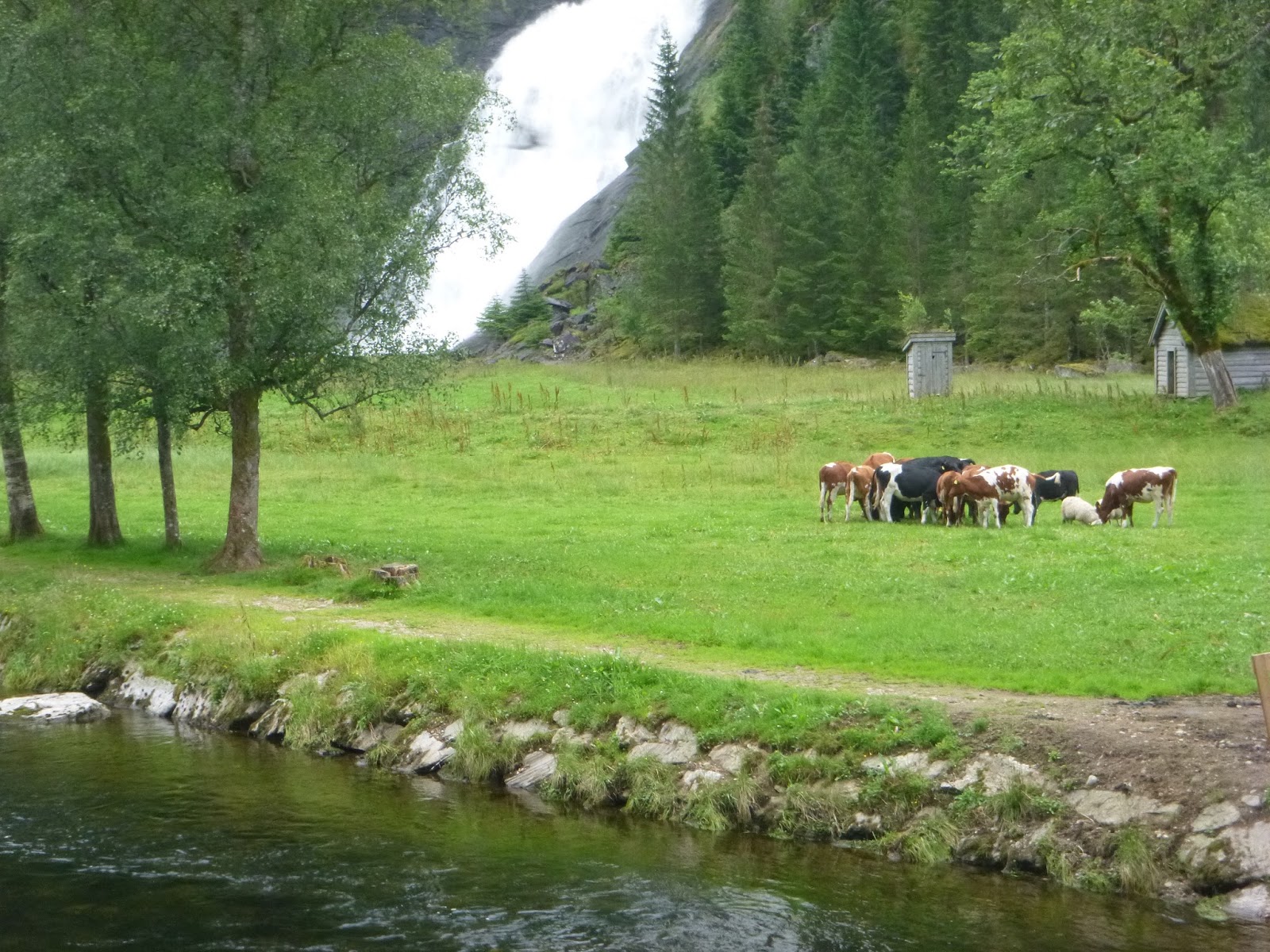
In the morning we made a short drive of about 65km from the town of Forde to the unpronounceable village at Byrkjelo passing the usual spectacular scenery on the way, such as the "Haldefosset" falls where we stopped nearby and walked up to.


This was definitely the best waterfall so far. Very unusual to see sheep and cattle so close together too.
 
We drove through our destination of Byrkjelo before we even realised, (you can walk the length of the village in 5 minutes), and because of the narrow main road we had to drive some way before we could find a turning place. We decided that a bus lay-by would do for our manoeuvrings and pulled in just in front of the bus shelter. We then noticed a Police car parked just behind the shelter, then two sheepish looking policemen popped out of the shelter where they had been hiding, whilst pointing a radar camera-gun through a tiny window in the side of the shelter.
We quickly realised that we were blocking their radar shots so gave them a quick smile and wave and drove on. It was about 2 km before we found a suitable spot to turn and reverse our steps, by which time the Plod had flagged down some poor sod for speeding. The moral of the story is to beware strange men hanging around in bus shelters!
  
The campsite at Byrkjelo is situated in a lovely spot and once the rain had cleared we had a great view back up the valley where the peak called Snonipa could be seen, (the one that looks a bit like Mitre peak in Milford).
 
Before the clouds had lifted.
 
 
 And after, with Snonipa in view.
 
After settling in the campsite, including Iris' customary and immediate sewage disposal inspection, which passed muster, we followed with lunch, then we took a drive up the (unnamed) river that ran through the valley whilst looking for fishing spots. The weather had turned very cold with a biting wind but we were not to be deterred and a couple of likely looking pools were identified as prime fishing spots. Iris took some sneaky photos of me fishing in the turquoise stream and then retreated to the comfort of the motorhome while I froze.
 
 
Afficianados will note that I'm spin-fishing, not fly-fishing, mainly because the river was too deep and swift to wade, plus a gale was blowing into my face that would have made fly casting very difficult. I'd bought a pack of 5 spinning lures of assorted colours at the local Co-op shop at a very reasonable price, (cheaper than the UK) and Iris was given the choice of which lure I should use. She selected one that she dubbed the "Norwegian Blue" because of its colour.
 
Anyway, the end result was the first respectably sized Norwegian trout that I have caught, or in other words tea.....
 
 I very rarely kill the fish that I catch but given the price of food in Norway, plus the advice from Iris' friend Penny about foraging for food in these climes, the trout was swiftly despatched and prepared for the pot.
 
I still had time to try a couple of other likely looking spots such as the one below, with no results other than a couple of minnows.


This little chap was released to grow into someone's tea. The lure that I was using was almost the same size as the fish, so it obviously didn't have an inferiority complex.
 
 
Hot trout with salad for tea.